
Retro Version 2 – RSI + Trend Following + Mean Reversion
DennTech Retro Version 2 pairs the proven RSI momentum indicator with two complementary directional strategies: Trend Following and Mean Reversion. This combination is designed to perform across a wider range of market conditions than a single-strategy build — trending markets are captured by the Trend Following component while sideways or oscillating markets are handled by Mean Reversion.
Included Strategies
RSI (Relative Strength Index)
Generates buy entries on oversold conditions and exit signals on overbought readings. In Version 2, RSI also acts as a secondary confirmation layer — Mean Reversion entries are skipped if RSI has not yet reached an extreme reading, reducing false entries during trending conditions.
Trend Following
Identifies the direction of the prevailing market trend using moving average alignment and momentum confirmation, then places trades aligned with that direction. Once a trend is confirmed the bot holds the position and trails a stop-loss as price advances, maximising profit capture on sustained directional moves without requiring manual management.
Mean Reversion
Mean Reversion assumes that prices deviating significantly from their historical average will return toward that average. The bot buys when price drops sharply below the rolling mean and sells when it recovers, capturing short-term corrections. This works especially well during low-volatility consolidation periods or when an asset is ranging after a large directional move exhausts itself.
Strategy Interaction
All three strategies run simultaneously with independent capital allocation. You can weight allocation to favour whichever strategy suits current market conditions or use equal weighting and let the bot adapt automatically.
Supported Exchanges
Kraken, Binance.US, and Gemini.
Who Should Choose Retro Build 2?
Build 2 is designed for traders who want the bot to ride extended directional moves (Trend Following) while also capitalising on short-term overextensions back to the mean (Mean Reversion). RSI acts as the gating signal — only entering a trend when momentum confirms, and only fading a spike when RSI signals exhaustion.
Typical Market Conditions Where This Build Excels
- Trending markets with pullbacks: Trend Following captures the main leg; Mean Reversion profits from the retracement.
- Post-breakout continuation: RSI confirmation reduces false-entry rates after news-driven spikes.
- Altcoin pairs with regular mean-reversion cycles: Many altcoins exhibit strong mean-reversion behaviour within macro uptrends.
Frequently Asked Questions
- Do Trend Following and Mean Reversion conflict?
- They are complementary in timeframe. Trend Following operates on longer candle windows; Mean Reversion targets short overextensions. Both run simultaneously with independent position limits.
- What RSI period is recommended?
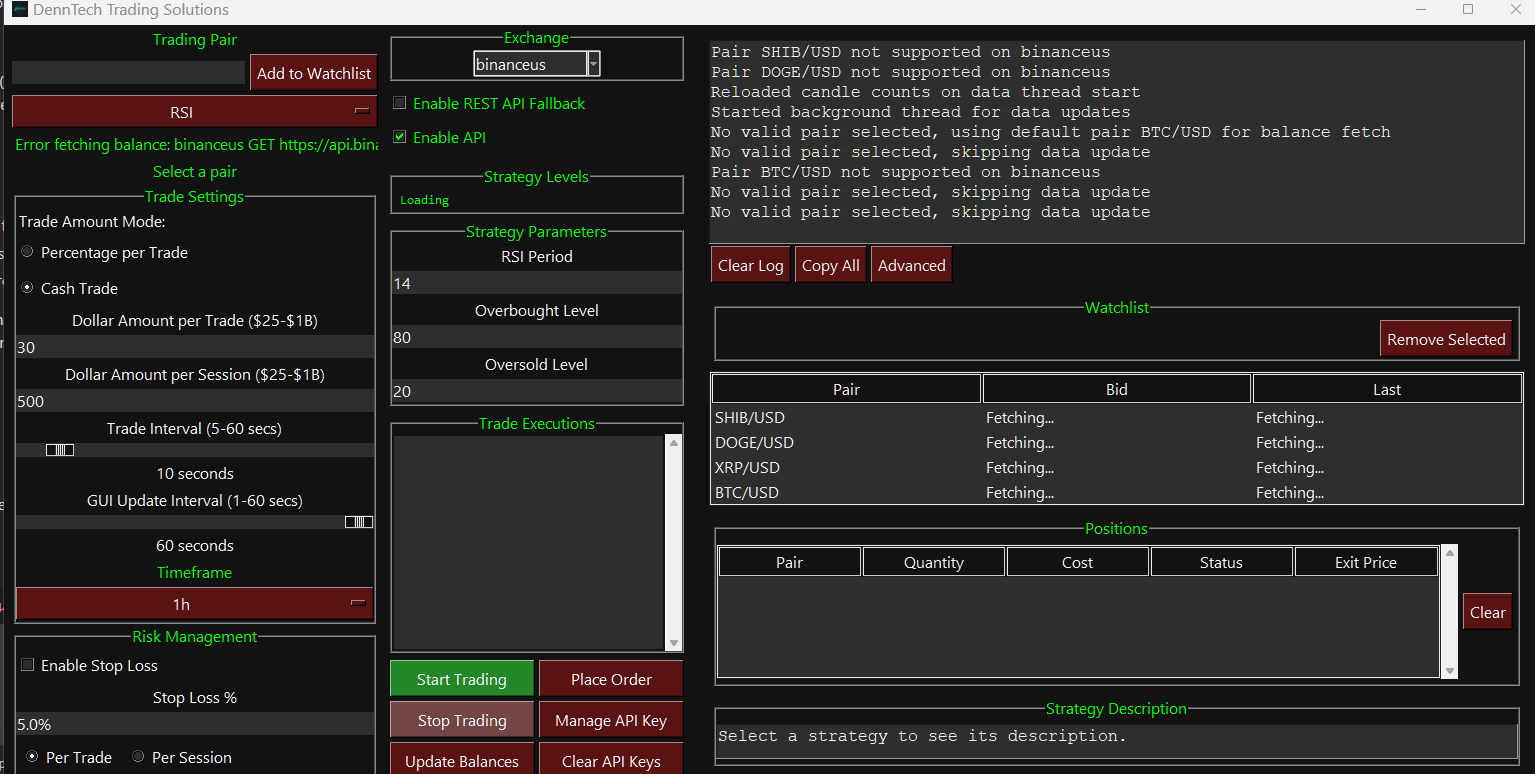
- 14-period RSI is the default and works well for most pairs. You can adjust it in the strategy settings panel to suit faster or slower moving assets.
- Is this build suitable for bear markets?
- Mean Reversion performs in any direction. Trend Following can be configured for short selling on supported pairs. See the docs for short-side setup.