
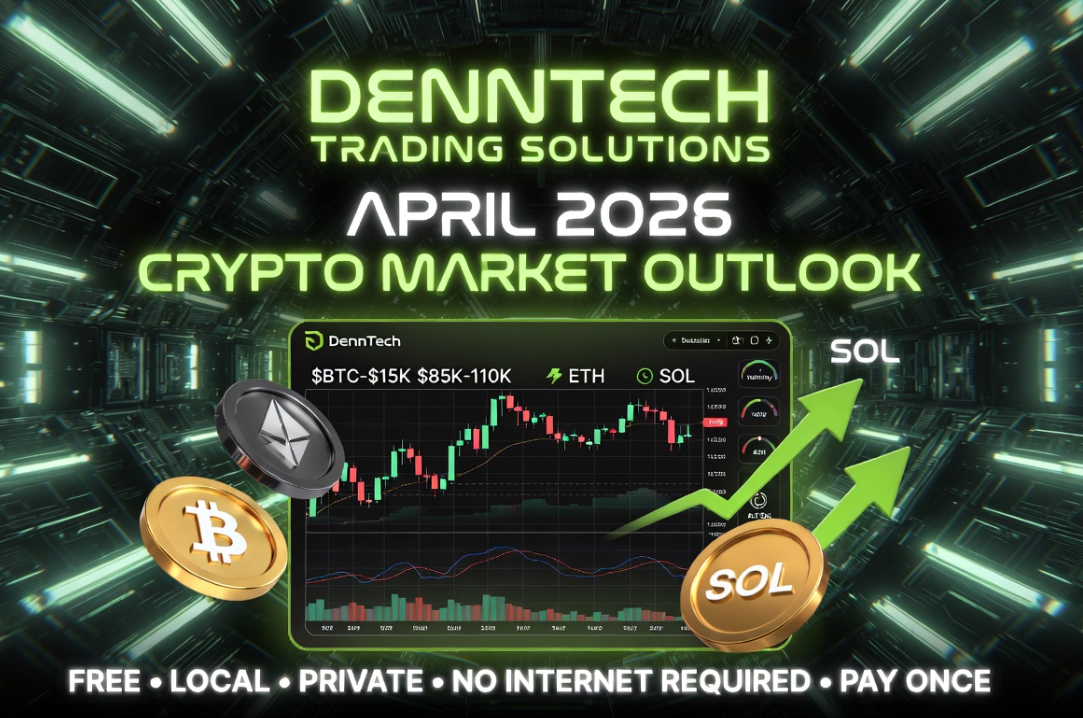
April 2026 presents a distinctive market environment shaped by the 2024 Bitcoin halving's second-year supply lag, renewed institutional inflows, and an altcoin rotation that rewards speed and precision over passive holding.
Where the Market Stands in April 2026
Bitcoin: Post-Halving Supply Compression Continues
The April 2024 Bitcoin halving reduced block rewards from 6.25 BTC to 3.125 BTC. Historically, the most significant price appreciation from halvings has materialised 12 to 24 months after the event, as the supply compression fully filters through exchange inventory and miner selling pressure decreases. April 2026 sits precisely within this historical window.
Bitcoin has been consolidating between $85,000 and $110,000 in Q1 2026, with multiple breakout attempts encountering resistance at the $105,000–$108,000 band. Volume analysis shows accumulation patterns consistent with prior pre-breakout formations. The market is coiling.
Bot implication: Trend Following and Momentum strategies are well-positioned for a sustained directional break. Mean Reversion and RSI strategies are capturing oscillation profits within the current range while the breakout materialises.
Altcoin Season Indicators
The Altcoin Season Index — a measure of whether altcoins are outperforming Bitcoin — has been climbing steadily since February 2026. Layer-2 tokens, DeFi protocol governance tokens, and AI-adjacent blockchain projects have led the rotation, with several mid-cap assets recording 40–80% gains in Q1 alone.
Altcoin season creates specific opportunities for automated trading:
- Momentum strategies capture the early-stage acceleration when a narrative begins gaining traction.
- Scalping strategies profit from the increased intraday volatility as retail participation rises.
- Arbitrage strategies exploit the price inefficiencies that emerge when rapid capital rotation creates temporary cross-pair mispricings.
Volatility: Elevated but Structured
Implied volatility across major crypto pairs has elevated significantly relative to the relative calm of Q4 2025. However, the volatility is not the chaotic, unstructured kind associated with crash events — it is directional volatility associated with active price discovery. This distinction matters for strategy selection.
During structured, directional volatility:
- Trend Following outperforms — the strategy is designed for exactly this condition.
- Scalping produces higher per-session returns due to larger intraday ranges.
- Grid Trading should have its upper boundaries set conservatively to avoid being caught in a directional break.
Strategy Performance Analysis: April 2026 Conditions
Top Performers in Current Conditions
Scalping — High Priority
Elevated intraday volatility on BTC/USD and ETH/USD creates an ideal environment for the scalping strategy. Wider intraday ranges mean larger per-trade capture opportunities. The DennTech scalping implementation targets micro-moves with tight stops, maximising frequency while limiting individual drawdowns. Configure on BTC/USD and ETH/USD for maximum liquidity.
Configured pairs: BTC/USD, ETH/USD, SOL/USD
Expected session frequency: 15–40 trades per 8-hour window in current conditions.
Mean Reversion — High Priority
Bitcoin's consolidation range has created a well-defined reversion channel. Assets bouncing between $85K and $105K respond well to mean reversion logic: buy the dip to the lower band, sell the recovery to the upper band. The DennTech mean reversion module uses Bollinger Band deviation as its trigger, which is well-suited to this type of structured ranging.
Momentum — Medium-High Priority
Applicable to altcoin positions. The momentum strategy should be applied to assets showing clear acceleration patterns rather than the broader market. Filter for assets that have broken above their 50-day moving average on above-average volume — these are the momentum candidates.
Arbitrage — Medium Priority
Altcoin rotation events consistently create temporary cross-pair mispricings as volume floods into assets on one exchange before others reprice. The DennTech arbitrage module monitors these discrepancies across Kraken, Binance.US, and Gemini. Current conditions make this strategy worth running as a complement to primary directional strategies.
Strategies to Use Cautiously Right Now
- Grid Trading on volatile altcoins: Grid strategies need range-bound assets. High-momentum altcoins can break grid boundaries quickly. Restrict grid trading to large-cap pairs (BTC, ETH) with well-defined ranges.
- Market Making on low-liquidity pairs: Altcoin season creates sporadically wide spreads on mid-cap pairs. Market making on thinly-traded assets can result in unfavourable fills. Stick to top-10 pairs by volume.
DennTech Configuration Recommendations for April 2026
Conservative Profile ($1,000–$5,000 account)
- RSI on BTC/USD — primary strategy, 40% of capital allocation
- Grid Trading on ETH/USD — secondary, 30% of capital allocation, tight range boundaries
- MACD on SOL/USD — tertiary, 30% of capital, trend confirmation filter active
Balanced Profile ($5,000–$20,000 account)
- Scalping on BTC/USD — high frequency, 25% allocation
- Mean Reversion on ETH/USD — range capture, 25% allocation
- Trend Following on SOL/USD — directional, 25% allocation
- Momentum on selective altcoins — rotation capture, 25% allocation
Aggressive Profile ($20,000+ account)
- Full all-strategy deployment across multiple pairs
- Arbitrage module active across all three supported exchanges
- Market Making on BTC/USD and ETH/USD for spread income
- Per-trade stop loss: 1.5%, session cap: 5%, trailing stop: active
Looking Ahead: Q2 and Q3 2026
If historical halving cycles hold, Bitcoin's most explosive price movement is likely concentrated in Q3–Q4 2026. Positioning now — during the consolidation phase — with a diversified automated strategy set is the approach that captures the full move rather than chasing entries after the break.
DennTech's Elite Version 5.0 includes all 25 strategies across five specialist sets, giving you the tools to navigate every phase of what promises to be a significant market cycle.
Key Considerations for Automated Crypto Trading
Selecting the right configuration for an automated trading bot requires balancing three competing priorities: signal quality, execution speed, and risk control. A well-tuned strategy minimises slippage by using limit orders on exchanges with high liquidity and tight spreads. For most indicator-based strategies, the 4-hour and daily timeframes produce fewer false signals than lower timeframes, making them the preferred starting point for new configurations. The strategies page provides a full breakdown of every strategy DennTech supports, including the indicators used, recommended timeframes, and risk parameters.
Risk Management Fundamentals
Position sizing is the single most controllable lever available to any bot trader. Setting a fixed percentage of capital per trade — typically 2–5% — limits the damage from any single losing trade and allows the strategy to survive extended drawdown periods. Pairing position sizing with a per-session stop loss prevents a string of losses from compounding into account-threatening drawdowns. DennTech's built-in circuit breaker halts trading automatically if losses exceed a configurable threshold within a session window, providing an additional safety net. Review the full risk management configuration options at the pricing page or get hands-on experience through the live demo.
Exchange Selection and API Setup
The choice of exchange has a direct impact on trading costs and strategy performance. Exchanges with a 0% maker fee tier — such as Kraken Pro, Coinbase Advanced, and Bybit — significantly reduce the cost of limit-order strategies. DennTech connects natively to 13+ major exchanges via API, with each connection using read-trade-only permissions to ensure withdrawals are never exposed. Detailed API setup instructions are available in the installation guide and the documentation section.
For complementary April 2026 analysis, see the crypto market outlook for April 2026 post.